

Featured Product

Project Type
LVVWD uses Optimatics software to manage assets and intelligently plan their pipe replacement and renewal programs by optimizing capital cost, business risk exposure, and hydraulic performance.
Customer Reference
Nass Diallo
Senior Civil Engineer, Planning Division LVVWD
Key Points
System Description
LVVWD began providing water in 1954 to a service area of around 45,000 residents. Today, the district delivers reliable, quality water to more than 1.5 million people. The District prides itself on using sustainable technologies to increase efficiencies and manage costs of water delivery in the desert. With the tremendous growth and development seen by the region over the last 60 years, once new assets are now deteriorating while new challenges continue.
Purpose
Like many utilities, LVVWD faces a number of different challenges when considering asset renewal and replacement strategies. Initially, there are more questions than answers:
LVVWD realized there had to be a better way to develop a holistic renewal strategy that not only focused on minimizing asset risk but considered hydraulic performance impacts and benefits. In a joint project with Optimatics, LVVWD piloted an optimization process in response to these pressing questions.
Project Scope
The project started with identifying the required data. Using InfoAsset (by Innovyze) and Fracta, LVVWD had already made significant efforts in developing probability of failure and consequence of failure scores to develop an asset risk index. The Optimizer™ Criticality tool was used to supplement the consequence of failure analysis by simulating the effects of a pipe break and subsequent pipe isolation in the water distribution system. A system-wide pipe criticality analysis was performed, automatically stepping through the network model, breaking and isolating each pipe in turn, and running a hydraulic analysis for each scenario. This resulted in quantifiable data such as resulting pressures and velocities, total demand that can no longer be supplied, the resulting number of customers isolated, and critical customers.
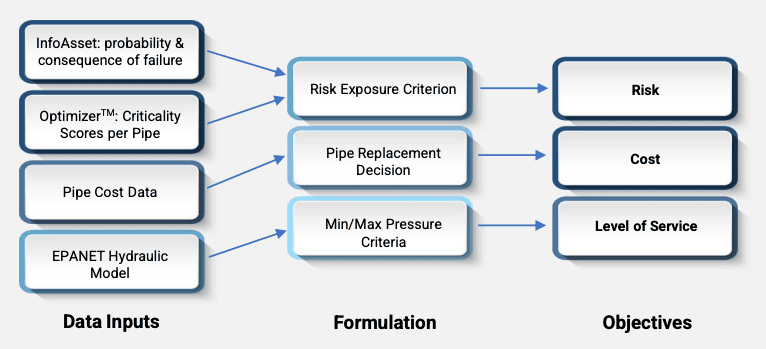
Optimizer was used as a data aggregator to couple risk with hydraulic performance and cost considerations to generate a multi-objective analysis.
Results
Optimizer and its unique multi-objective approach allows LVVWD to consider many criteria, leveraging pipe risk data, criticality scores from the Optimizer Criticality tool, pipe cost data, and pressure criteria informed by hydraulic models in EPANET.
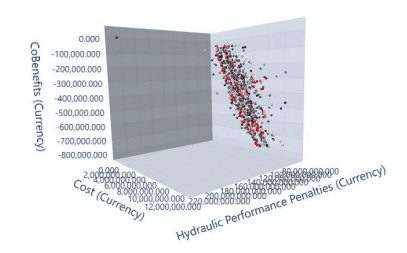
The results of the project provided LVVWD with better understanding of where the system is most vulnerable to outages (breaks and isolations). The results assist with planning the annual pipe rehabilitation and replacement program by identifying more effective spending of pipe R&R dollars. Relatively minor network improvements will improve security of supply to a large number of customers in many cases.
The optimization helped improve system redundancy and lower risk by strengthening key areas of the system, allowing LVVWD to be more proactive in preparing for probable pipebreak incidents.